Summer Fellowship Reflections Part 3

Coming together in conversation is a theme in all these pieces I’ve been receiving.  Conversations that have expanded past my individual conversations, to the power of witnessing large organizations, world leaders, churches, non-profit organizations, corporations, and foundations coming together around a common purpose. One of the powerful examples of this was observing a day of meetings for an international coalition that is working on child nutrition issues (http://www.thousanddays.org/). I sat wide-eyed as we heard from ambassadors, presidents of NGO’s, the president of the World Bank, UN members, Secretary and staff of the State Department, Melinda Gates for the Gates Foundation and others, all coming together to discuss how to improve nutrition for pregnant mothers and children under the age of two in the 20 most undernourished countries in the world.  Each group brought their own expertise, interest and angle. All came together under the common purpose and met at the table to look at how to move this work forward.  I got teary as I heard the fourth person that morning talk about the importance of exclusive breastfeeding and the studies on how infant nutrition has a profound impact on a child’s ability to develop.  If the voices that represent these major initiatives can come together in the same room to talk about changing children’s lives. . . anything is possible. Change is happening and we can each be part of it.

Piece number three. Food is part of my calling and ministry. I think I’ve known this over the years. It’s shown up in my deep love of gardening, in the faces of hunger and poverty I’ve seen in my travels, in the high I get every time I’m let loose to sort food at a food bank.  In Swedenborgian theology, bread, and food in general, represents love, and you can quickly make a variety of connections around the importance of food, love, faith, church and spiritual and natural hunger.  Being at Bread for the World for the summer, and being exposed to the DC scene in general, has been invaluable in expanding my view of the importance of policy and advocacy around food.  From the Farm Bill, to international aid, to commissions on nutrition, the core human need of sustenance is woven through policy and politics. As I grow in understanding my role as a voice in the public square, I simultaneously find myself narrowing in and feeling out where specifically I’m being called to serve.

On my last Tuesday in DC I had two opportunities that helped me to see and articulate this in myself as I watched my heart jump.  Bread for the World hosted a brown bag lunch with a presentation from Food Resource Bank on their work to rally people in the US to use agriculture to raise money to support agricultural efforts in the developing world. I was intrigued as I heard a woman from Kansas describe her church coming together with two other churches in the area and facilitate the farming of 20 acres of land that raises thousands of dollars a year that that then enables local sustenance farming in communities in other countries.  I found myself leaning forward in my chair as Javier Ramirez and Casto Mitha, farmers from Bolivia, talked about their work to bring traditional and innovative farming techniques to their village, and described how nutrition and general wellbeing have been drastically improved in a few short years due to a few simple initiatives.

Later on Tuesday afternoon I had the honor of getting a tour of Miriam’s Kitchen, an organization that provides high-quality meals and support services to the homeless men and women in Washington DC. Deputy Director Catharine Crum generously came and spent an hour with us, sharing the story of Miriam’s Kitchen, showing us around the facility, and introducing us to their guests and volunteers. I could wax on about the various pieces of wisdom, insight and inspiration that I gained from this hour, and maybe I will in some future post. But succinctly I’ll say: I saw a ministry at work that captured my heart and threw another possibility into the swirl of “What’s God Calling Me To?” Soup that is simmering right now.

This question of “What’s God calling me to?” might be a good one to wrap this piece up with, as it is the thread of this summer experience, and I believe of all of our lives in general.  I look back across the years and see how the Lord has been leading me from conversation, to experience, to doors opening and doors closing, all building on one another and moving somewhere. It’s trite but true to say the path twists and turns and doesn’t look the way I’d pictured it.

But it’s from this image that I can also say with amazement, gratitude and confidence: it is clear to me that there is a loving Force greater than me that is guiding and a stream of Providence and I can flow with or fight against.  I look at the parts of my being and calling that have been highlighted for me this summer: The call to write. Stepping into the faith/policy conversation. Being a preacher. Social-justice work. Developing a Swedenborgian social-justice movement. Integrating feeding and hunger issues into my ministry. At moments these seem like isolated entities. How do they fit together with my long-time callings to church planting? To pastoral work? To creating nurturing spiritual community? To raising up leaders to plant more churches? To sharing the transforming theology and spiritual work that I’ve been blessed to stumble upon?  How can all these things be part of one human’s little journey on this earth? And that’s where the Divine continues to invite me to take a deep breath and feel the swirling slow down for a moment. If these pieces are all part of me a creation of God’s and an instrument of the Divine work, then it’s not up to me to know what the puzzle is going to look like in the end. My job is to be on the look out for the areas where the blue of the sky meet up with the purple of the wildflower. My work is to notice the edge piece that holds the definition of what’s continued inside. My task is to wake up each day and ask, “What is it today, Lord?” and then have the strength, courage, humility, tenacity, gratitude and laughter to do it.
Summer Fellowship Reflections Part 2

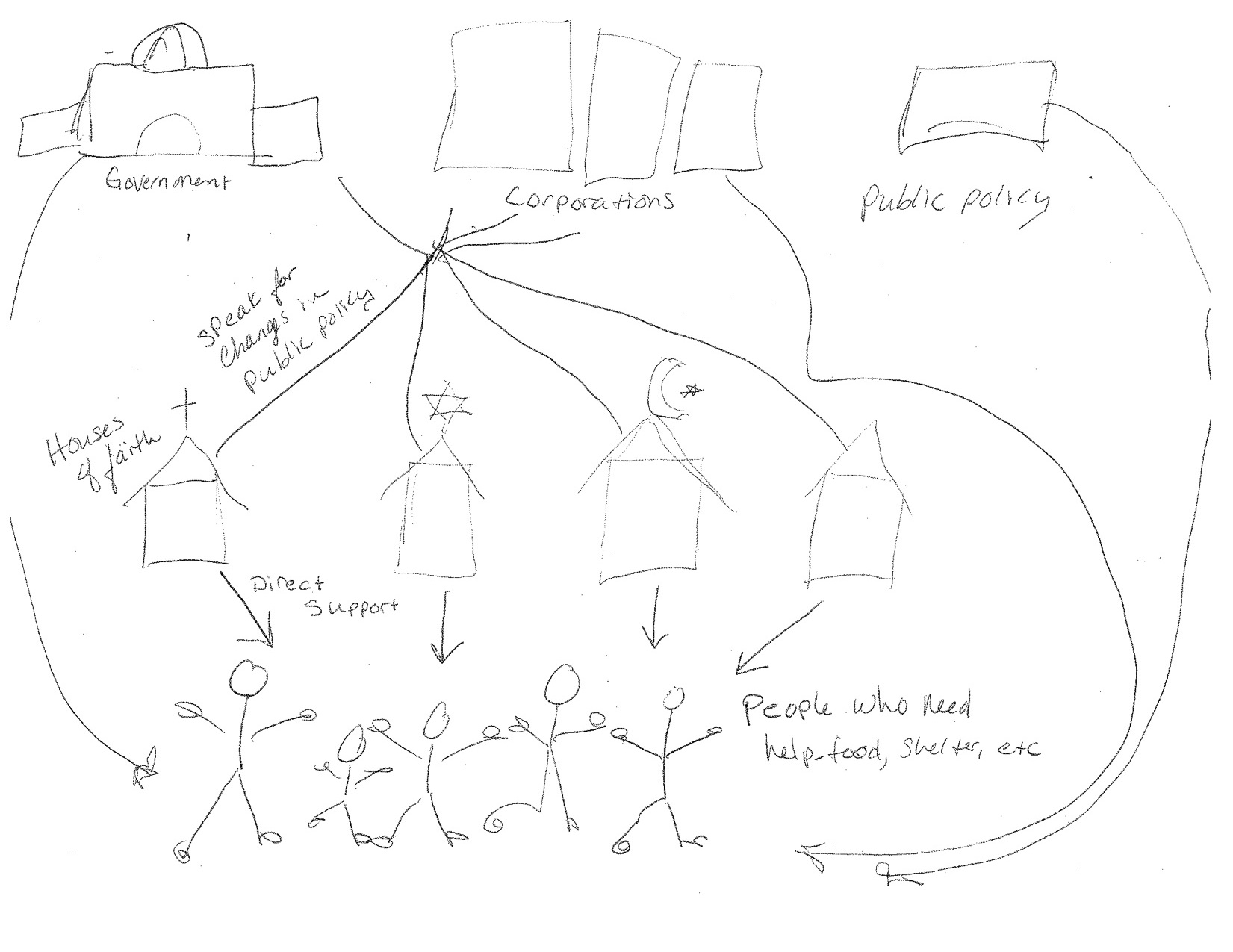
At our first Beatitudes Fellows meeting, the eight of us sat down with Anne Howard (director of the Beatitudes Society) as she shared a vision for the society and for our summer work. She pulled out a scrap of paper and drew a diagram that looked something like this:    

The idea is/was that faith and community-based groups have been providing and will continue to provide direct service (soup kitchens, housing support, etc.) to those in need and that this is a good thing! But we must also ask the question, as people of faith, what is our part in helping to change the overall systemic issues that create a society where people are hungry, homeless, and lacking education and opportunities to thrive? What is our role as people of faith, in looking at how large corporations, government, and the decisions of powerful leaders have a direct effect on the levels of poverty and struggle in the world?

Now I know this concept isn’t brand new news and we can say, “Yeah, yeah, been there, done that.” But something struck me that morning. Suddenly I was one of the people who not only could be, but was in the process of being called to a voice from the faith community to speak up for change and transformation in our world. This was different for me. I can no longer be a friendly observer, I cannot hide behind my desire to avoid offending or disagreeing with anyone (be they my friends or people I’ve never met).  I cannot quietly go about my life and be sure that “someone else” was taking care of it all. In that room that day a piece clicked—whether at the end of the day I like the fact that faith voices are intimately involved with policy and governance, the reality is that currently they are. Rather than resisting and considering myself apart, I am being moved to show up and be in the conversation. I am called as a person of faith and a faith leader to prayerfully and humbly, confidently and clearly, speak into conversations that are integral to how people are being treated and how our society operates.

Conversations, that’s another piece that is showing up all over this puzzle.  During my second fellowship week, Bread for the World hosted its bi-annual gathering, including Lobby Day where we were trained, empowered and sent to the hill to talk to our congressional leaders. I will confess that I had some anxiety about this plan. There’s something a wee bit intimidating to think about entering these towering buildings, through security, and sitting down with “CONGRESSIONAL STAFF”.  The night before Lobby Day I was walking back from the metro, thinking and praying, and the Still Small Voice whispered, “It’s a conversation. You know how to have conversations, Anna.” Oh. Yeah, good point. I’ve taken that moment with me into a number of house and senate office meetings and have had the opportunity to not only enter into conversations, but begin to build relationships with some of the staff of my congressional offices, including (by chance) a house rep that I’m being nudged to reach out to. Conversations. Conversations change us and when we show up and keep listening and speaking, I actually believe change can happen. I think when we can sit across a table and look at another human being, connect on things we care about, and truly engage in each other’s views, the Divine shows up and moves. To be continued . . .

Summer Fellowship Reflections Part 1

It was in early February that it consciously hit me: I have a summer ahead of me with no obligations, no full-time job, no mortgage tying me to one location, and granted, no means by which to eat and pay the bills.  The opportunity of being a graduate student, and having flexibility and mobility in the summer was not lost on me, having been in the cycle of year-round employment for the past decade.  I began to search summer internships and fellowships and soon ran across the Beatitudes Society (thank you google). “Their mission grabbed me — “Strengthening the progressive Christian network for justice, compassion and peace” as did the snapshots of the fellowships they’ve administered.  I was intrigued by the breadth of organizations that were represented and found myself getting excited about a number of the positions.

Fast-forward through research and applications, interviews and paperwork, preparation and travel . . . here I am at Bread for the World in Washington DC, sitting in my cubicle where I can glimpse the capitol out the window if I strain my neck in the right direction.  I am surrounded by a floor full of people who are committing their time and energy to urge our nation’s decision makers to lead in a way that furthers the elimination of hunger, both in the United States and around the globe. Each person comes from a different path of faith, coming together around the call to follow God by speaking up for the poor and hungry.  My supervisor made the comment, “If you walked around this floor and asked everyone their theology on communion, consensus would not be found. But what we all have in common is the desire to put an end to people being hungry.”

It was this laser beam pointing back to the mission at hand that attracted me to the organization and has sustained and led me through this fellowship. I still have questions about how we navigate faith, policy and politics. I find, as with any human organization, that there are flaws and frustrations. I get overwhelmed at the breadth of work to do. But the laser keeps cutting through: “What can we do so that fewer people die from hunger in our world?”

As the fellowship comes to a close I pause and reflect back on what I’ve learned in the past eight weeks and how I’ve been changed. Because changed I certainly have been. It feels a bit like the first time I went to West Africa in 1999—I knew within days of being there that I would never be quite the same again after seeing the faces, smelling the air and having the rich red dirt seeping into my skin.

This summer I’ve been changed. Pieces that have been gathering over the years have found places to fit, I’ve found some edge pieces that give framework for the image, and the puzzle continues to evolve. To be continued . . .

Love’s perfection

Love’s perfection
by Terry L. Chapman
A reflection on Matthew 5
“Be perfect, therefore, as your heavenly Father is perfect.”Grace seems too good to be true
In the hearts of those
Whose God is too small
Whose love demands perfection
Whose acceptance has some other
Source than God’s own endless compassion

The one whose experience of life
Tells a different soiled story that
Cannot be reconciled with divine
Demands for perfection wanders
Lonely and confused in unfreedom
Lost on the wide path of autonomy

Sit for a while, you are in good company
Let your anxious grasping to be
Something else, someone else, somewhere else
Be quiet and still- watch as now, just now
The gate that opens to the narrow path in
the center of your being swings as if

Moved by a gentle breeze
Even breath flowing from
The very heart of God
Carrying upon its fragrant currents
A love song that awakens

What had slipped into deep sleep

Thanks to MINemergent for popping this in my inbox this morning.

Messy.

Today I’m working on finishing up my fellowship project and reading through all the material that I’ve been preparing to get uploaded. This quote just about jumped off the page as I read it. This basically summarizes my experience this summer. Couldn’t say it better myself, so I won’t try.

“We realize that no one is going to come along and hand us truth, justice. We get that only in comics and in the movies, not in the real world. The real world is a messy, complicated place, where there are many hard questions, no easy answers, and lots of work to do. But inside of all of us there is the capacity to live up to the potential given to us as human beings created in God’s image. . . . We can make the world a better place. Bring the dream of redemption a little closer.”

-Rabbi Robert Levine, There Is No Messiah and You Are It

Rare Day

I was reminded recently of this poem by my late grandfather about my little sister who was around 5 at the time. It’s been reminding me to appreciate the little things the last few days.

Rare Day
By Dave Gladish

What’s easily so rare as a day in June
is a day in May, when
a five-year-old decides to lend
her grandma and her grandpa,
as a forty-fifth-wedding-annive​rsary gift,
a love-worn rag doll for a whole month,
just to enjoy.

What the Dalai Lama Said to Me

Woke up in time to miss my train and arrive on the West Lawn of the Capitol in time to ease into the group of people who just got our piece of lawn before they close the area.  I settle in on my bright batik sarong, Rebecca and Kate next door on a white beach towel. We share snacks and sunscreen and look over the multiple thousands of people who have pushed through the crowded streets to come together to hear from, and be in the presence of, one of the great teachers and humans on earth—His Holiness the Dalai Lama.

 The Dalai Lama is in Washington DC for 10 days, teaching and leading in an event for world peace (http://www.kalachakra2011.com/). This morning is the big public, and free, event and the city has turned out for it.  People who look to be from many walks of life, young and old, multi-cultured and diverse, all gather together in the sweltering sun, sweating with the hope of peace.  The event starts and dancers and musicians begin, an ethereal sound spreads out over the area, reverberating tranquility and invites our focus to the stage.

I’ve had a number of people ask me in the last 24 hours, “So, how was it? What was it like to see the Dalai Lama? Did it change you?”  I’ve searched for words to answer, specific sound bites to share, and keep coming up short. I can’t say “It was the most profound and amazing 2 hours I’ve ever spent!” or “He was so charismatic that I clung onto every word.” And yet, that was what was so profound. His humble, deeply wise presence could be felt, even up on the top corner of the lawn, hiding in the bit of shade under my umbrella. I didn’t hear every word, some lost in the air and accent, some peacefully washing over as I pondered the sentence before. Each word was obviously gently and carefully chosen, but none demanding me to cling to them.  I heard every laugh. That I know. His laugh gurgled out with the innocence of a toddler, in-filled with the depth of the wise elder that he is. He laughed at himself and laughed at human nature, embodying the joy and lightness that he was speaking of.

“But Anna, you must have heard something of his message, his words, that stuck with you that you can share.” I’ll try to capture a few gems into words to share.

The first gem comes from Nelson Mandela, who gave a video address introduction. President Mandela spoke of his respect for the Dalai Lama and for the leader he’s been for a more peaceful world. Then he addressed the crowed, “It’s your turn”. He went on to remind us that something he and the Dalai Lama share in common is that they are “retired men”, they have lived their life of public service, incredibly sacrifice and world-changing leadership. He offered the image of he and the Dalai Lama sitting on his front porch sipping rooibos tea and watching the grandchildren play.  “It’s your turn to work for peace” he challenged us.

This charge caught my attention, and quickly brought a flood of internal dialog. “Yeah, right, us the next Mandela?”  “How could any of us sitting on our beach towels, downing the bottles of water being handed out by orange shirted volunteers, every come close to the work that these two great humans have done?”  That’s when the Dalai Lama entered the stage. We all stood in reverence, he stood in greeting and then told us that his favorite way to speak is not a speaker to a crowed, but person to person, in a conversation, so he would be sitting in a comfy chair. Besides, “It’s hot and the chair is in the shade”. He sat and began to talk.

He talked about how world peace comes through inner peace. He talked about how every human craves for inner peace and seeks it in many ways. And he reminded us of our shared humanity and that every person is part of the global solution to peace. He challenged us to look inside and think about how we are seeking peace in our own heads, in our internal dialog. He asked how we are treating the people who we share a home with, our spouses, children, parents, our co-workers, the people we meet on the street.  It is in these interactions that the ripple will start and move outward, meeting other peaceful currents and sweep the nations with a tsunami of compassion and peaceful living.

No one is exempt from being part of the global solution and no moment is apart from the opportunity of peace.  It’s our turn. Our turn to live in the way of peace and justice, radical compassion and relentless dedication and devotion as our elders have done.

And His Holiness didn’t let any one path off the hook, or offer the “right” way. He spoke eloquently about the variety of religious (and non) paths, the many tools that can lead to a life of compassion. He spoke of the importance of growing an intelligent mind and a warm heart. He spoke of teaching compassion in all contexts, sacred and secular and how embodied compassion is the way of religious life. He reminded me of one of the Swedenborgian teachings I hold dear, “All religion is of life and the life of religion is to do good”. It is the life we live from what we believe that matters. Regardless of our life circumstances, religious holdings, or stages of life, we have a part to play.  He broke down any walls of excuses or “not me” and with his raw humanity and humility called us to a higher place of compassion, justice and peace.

I can’t remember the last words he said. I do remember his smile though, kind and wide on the big monitor and moving with the bright red of his robe that I see getting up from the chair on the stage. Still shining as he walks down through the crowed and the music begins to play.  We begin to pack up our things and roll our blankets. A quiet is over the crowed. If we can all be peaceful together for 2 hours, in 90+ weather in the middle of the charged swirl of the Capitol City of the United States…maybe peace can continue to seep into our world.

A Prayer of Paradox

This prayer was offered by Kathy Pomroy at the Bread for the Word Gathering a few weeks ago. It spoke to me of the paradox we find ourselves in as we make our attempts to serve God and other people, live in the world around us, be present in the moment and welcoming a new day of God’s reign on earth.  

You are welcome here.

Whether you have come across oceans, borders, state lines or simply across town, you are welcome here; you are welcome in this house.

We call God by many names, differing by faith and language, but we are joined in a common desire to see a world free of hunger and hurt.
Let us pray together to bless this time and food.

Loving God,
We find ourselves in a strange place –

We are surrounded by beautiful chandeliers, comfortable chairs, a banquet of food before us, but we are here to talk and act on hunger.  God, this is a strange place,

In a rich nation and world, millions and millions and millions of children are hungry and parents struggle to feed their families.  God, this is a strange place.

In a country with wealth beyond reason, many of our nation’s decision-makers are seeking to balance budgets on the backs of the poorest people.  God, this is a strange place

God, our God, where are you?  Where are you, God, in this strange place?

But God, you do not leave us alone in this place, in this world.  You take many forms, but those with eyes to see and ears to hear, we do see you.

We see you as parent – when food is prepared for us and our basic needs are met.
We see you as parent, O God.

We see you as teacher – when you bring all of us together from across the world to learn from experts and one another about hunger and nutrition.
We see you as teacher, O God.

We see you as love – when someone shares a kind word with us or helps us with things big and small.
We see you as love, O God.

We see you as power – when you send us forth to speak truth to power on Capitol Hill or back in our home countries or in our neighborhoods and home towns.
We see you as power, O God.

So God in this strange – yet beautiful – time and place,
Help us to know that this is your time and place.
Help us to know that this is our time and place.
Help each one of us to know and to be love and care, to know and to be teacher and learner.
Help each one of us to be your hands, your feet, your eyes and your mouth

As together we build this world, your world, our world – a world free of hunger.

Amen


Off the Shore

Here is a river flowing now very fast.
It is so great and swift that there are those who will be afraid,
who will try to hold onto the shore.
They are being torn apart and will suffer greatly.
Know that the river has its destination.
The elders say we must let go of the shore,
push off into the middle of the river
and keep our heads above water.
Hopi Indian prophecy