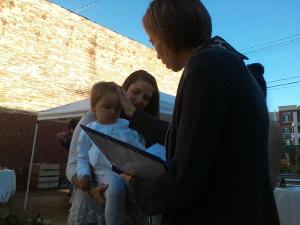
Enough and Some to Share

TGC10

Rev. Anna Woofenden
7/31/2016

Listen to the Audio of this week’s sermon 
Scripture: Genesis 41 and Luke 12:13-21

Before I begin, a disclaimer: I know it’s not Christmas, but I’m going to use a story from “It’s a Wonderful Life” anyway.

Do you remember the scene at the very end of the movie? After Uncle Billy loses the Bailey Building and Loan’s $8,000 deposit and the small bank fails the bank examiner’s inspection, George Bailey is at his total and complete wits’ end. Where will he come up with the money to save the town and save his family? He sees no hope, and is preparing to end his life when an angel comes along and leads him through visions of what life would have been like if he hadn’t been in it. He saw how his brother would have drowned, how his mother would have suffered, how the town would have gone downhill had he not been part of it. Having seen how his life really did matter, he runs back to his family where his wife Mary has been rallying the town, and they collectively have come up with enough money and good will to get through the crisis together.

Now, you could say that this story is all about money, or a lack of money, that this plot line is all about economics. Yet, as anyone who watches it knows, the narrative invites us deeper. There’s something else going on here, something that holds both the reality of the physical needs and the deeper truths about spirit and heart and community.

Imagine with me for a moment the last scene for example: that iconic moment where George is receiving baskets full of money and his old high school friend calls from London and pledges $25,000… if you took that snapshot at face value, one might say it was all about the money, and yet, what is the feeling in that scene? It’s so far from greed, or being hung up on material possessions. The feeling is all about the people, the closeness that comes after desperation, the preciousness of family when you’ve glimpsed your life without it, the generosity of community coming together and offering the little they had to make together enough, enough to save the family and the town.

Some who read our parable of the rich man today might read it purely on the physical level, and go on to conclude that, “money is the root of all evil,” but I don’t think it’s that simple (besides, it is misquoting the original phrase which is, “the love of money is the root of all evil”). Instead, I would posit, selfishness and greed are the roots of evil, and whenever we are selfish, whenever we are greedy, this is the problem. Money, material things, clothing, houses, cars, any material possession are not innately good or evil; it’s what we do with it, why we do what we do, who we are serving, and how we interact that matters.

We had two parallel stories in our scripture readings today, both having to do with the storing up of grain—of material things—but each with drastically different intentions and markedly different results.

In the story of Joseph in the Hebrew Scriptures, we see how God guided Joseph to not only save the people of Egypt from starvation, but also save his own family, as he was led in the interpretation of dreams that there would be seven years of plenty and seven years of famine. Joseph was a good leader and an efficient manager. He organized storing up grain during the years of plenty, most certainly building barns and putting away the grain, in order to be ready to feed the community during the seven years of famine.

Then in the parable, Jesus tells us in the gospel of Luke that this very same action is not good. Jesus gives the example of a rich man who has an abundant harvest, and doesn’t have the storage facilities to keep it. The rich man asked himself, “What will I do? I know, I’ll build bigger barns, then I’ll store the abundant harvest so that then I’ll be set and I can relax and eat, drink, and be merry.” But then God replies to this rich man, “Fool, this very night your life will be taken from you, and these things you have prepared, then whose will they be?” Jesus ends the parable with these words: So it is with those who store up treasures for themselves but are not rich toward God.”

So what do we do with these two stories? What do we do when the Bible seems to contradict itself, to be telling us two completely different messages?

This is one of the many places where we have the opportunity to hold the “both/and” that we often talk about here in our community. Not holding one exclusive or particular way of reading the text, but instead knowing that God is in the complicated, in the messy, and is always drawing out that which helps us to love God and love neighbor. When we hold these two texts together within a both/and reading, some interesting themes and messages start to emerge.

Here we have very similar situations and actions—an abundant harvest and storing up into barns—yet the motivation is different. In the story of Joseph, his reason for gathering up the harvest during the seven years of plenty and storing it away is for the common good. Whereas the rich man’s response to an abundant harvest is self-centered; his storing up is only for his own enjoyment and false sense of security, and doesn’t take into account God or others.

What arises for me from these two parallel stories is this: Motivation matters, intention matters, and the reasons we do the things we do matter.

It’s not the storing up that’s bad—but the question is, for what purpose? Saving for future material needs is one component of proper stewardship of God’s bounty. Appropriate concern for the future is balanced, however, with awareness of how the love of God and neighbor are involved. To be aware of how our choices affect all facets of our interconnected system, to make choices that take the marginalized into account, to give freely and generously of what we have to others, to be good stewards of what we’ve been given.

The rich man is not set as a negative example because he had the abundant harvest, or even because he was going to build bigger barns, but because with all the excess in his life, he turns to only pleasing himself. He gets stuck in that trap that we so easily can as well—that the goal in life is the abundance of possessions. We are encouraged to spend more, have more, use more, supersize and maximize. We start to believe that these are the signs of a good life, yet these are the signs of the external. What actually goes with us—what lasts? This parable reminds us, it’s our hearts, our interactions with others, our intentions and loves that endure—where your treasure is, your heart will be also.

In one of Emanuel Swedenborg’s books, he talks about what people are asked after death as they prepare to gravitate towards heaven or hell. Rather than asking, “What is your belief?” or “What are the things that you think about faith and religion?”, we are instead asked, “What is your life?” What is the life you lived? How did your faith and beliefs lead you to a life of useful service, a life in relationship with God, a life of serving our neighbor? It’s not whether we have grain in barns or material wealth, it’s really how we live and operate within whatever we have.

Being rich in God transcends economics. Being rich in God does not deny our need for material provision, for homes and clothing, beauty and food. But being rich in God is not dependent on it. Being rich in God, is responding to whatever comes our way, whether it’s abundant harvest or deep financial hardship, with knowledge that in the end, it’s where our heart is and what our actions have been that matter. We are all interconnected, and the choices we make for ourselves are part of the effect for many.

When we have our community meal later in our gathering, we’ll sing our blessing song as we go to dinner, “there is enough, there is enough, there is enough, enough and some to share.”

Our two stories today invite us to look at that fundamental question, a fundamental choice of how we show up in the world. Is there “enough and some to share?” Do we believe this?

Do we believe this when we’re living on the street? Or when our next child needs to go to college? When the car breaks down and then the refrigerator quits? What is our response when we encounter extra abundance in life? Is it to rush out and buy that thing we’ve been drooling over, or squirrel it away for a rainy day? Far be it from me to say that there is one right response to any of these scenarios. But what we have in this parable today is the invitation to pay attention to our responses and to our motivations and intentions in the choices we make.

On some level, we can all get stuck in the trap of thinking that material resources will save us.—if we just get_____, it will all be okay, if I figure out how to pay for this thing, if, if, if… Ultimately, we know that being rich in God is what matters; where our heart is, our treasure will be also.

And this awareness of our motivations and intentions applies to times of abundance, and it applies to times of loss and lack and struggle too. Providing for basic needs, saving for the future, being able to enjoy life, these are important things, and I believe that they are within the realms of faithful following. And wanting these basic necessities, working for them, this is right and good.

Just as we are given the invitation to read and hold scripture with a both/and attitude, we are invited to hold life this way too.

We need money and resources in order to survive in this culture and world. Truly everyone should have a clean safe house to live in, to be able to eat, to have access to education and clean clothing. Everyone should have the opportunity to sleep peacefully and not worry every night about their safety or where their next meal will come from. And yet, we’re not there yet. Some of us live in nice homes, others of us are camping out in the parks, some of us have to keep a super close eye on the bank account each month before we write our rent check and worry about making ends meet, some of us never know where our next meal is coming from. There is a both/and reality in our world and a both/and reality in each of our lives. And, there is an interconnected reality—each of our lives is intertwined with the lives of others, as well as with God.

And so each one of us, all of us, individually and collectively, is called to pay attention to the both/and of these stories and the both/and in the world around us. We’re called to pay attention to what is our relationship is to the material things around us: How do we respond when we encounter abundance? How do we respond when we encounter scarcity? And this is another reason we need to be in community, to keep interacting with each other, because it reminds us that it’s not all about us. Each of our choices impact the greater web of economics, of systems, favoring some and not others.

And this is why we need to commit, and then re-commit ourselves to a life where we ardently believe in the provision and abundance of God, and take it upon ourselves to be faithful stewards with whatever is given us. And with whatever is given us, whether it is incredible material wealth, or a bowl of soup, we can take into account the needs of others and we share. Be it sharing a piece of our burrito with someone, giving a percentage of our income to the church and organizations we believe in, opening our home to a family member in need, or helping the person in front of you in line at the grocery store. These practices, these actions help to change us from the inside out. They shift our focus from the “it’s all about me” of the rich man in the parable, to “how can I faithfully be part of feeding the greater whole” of Joseph. Remembering that we are all connected—part of God’s interconnected web of life—and that somehow if we all engage it and show up to it, that there is enough, there is enough, there is enough, enough and some to share.

“How the Encounters Will Change Us” New Church Live, PA – Video 5/22/2016

Watch and listen to Rev. Anna Woofenden’s talk at New Church Live in Bryn Athyn, PA.


To support the ongoing ministry at the Garden Church…give your offerings here: http://gardenchurchsp.org/donate

“Listen Through the Fear” Sermon for 6/19/16

13442640_1813793075520059_4932942184695011945_o

Rev. Anna Woofenden
Audio:
Scripture: 1 Kings 19:1-15

“God’s love goes forth not only to good people, but to evil people. God loves not only those who are in heaven, but also those who choose hell, for God is everywhere and forever the same.” –Emanuel Swedenborg, True Christianity 43

When I was a child, I was very afraid of wind, and earthquakes, and fire. My fear of fire was probably primary—growing up in a house with a wood stove and attention to fire safety, it was ingrained in my psyche at a very young age that fire was something to be careful with and that if it was out of control it could be very harmful. I remember having a reoccurring nightmare that people were marching around our house with gigantic rhubarb leaves, which were on fire. Strangely it wasn’t that there were people marching around our home, or the oversized produce that scared me, it was the fire.

These fears subsided some over the years, though bits of them still remain. One can say, “Don’t be afraid” and work to not respond out of fear. But there is also some reality to these things. I learned that some of these of the fears were legitimatized, when a friend’s house burned to the ground, when the windstorm blew a tree onto a neighbor’s house, and seeing San Francisco after soon after the large earthquake in the late ‘80s. These things I was afraid of were real.

I have been struggling with feeling afraid this week, and walking with others who are afraid. Afraid for our communities, afraid for our nation, afraid of the ramifications of seemingly greater and greater divides between people and groups, afraid of guns, and violence. I’ve been feeling afraid for the children and teens I know who have come out or might. I’ve been hearing from my queer friends and people of color about their fears, and the fears that they live with day in and day out being confirmed. There are things to be afraid of.

The prophet Elijah in our scripture today was afraid. And he had good reason. After having a showdown with the prophets of Bael and winning, Queen Jezebel is not happy and is after him, and he’s on the run. He’s so afraid of being caught and killed that he runs out into the desert, prepared to die.

It was out there in the desert, in his place of utter despair, that an angel of the Lord comes to him. God meets him out there in the desert—fear and all—and provides for him. An angel brings him water and a cake baked on hot stones, and nourishes him and provides for the next leg of the journey.

And then the Lord asked, “What are you doing here Elijah?”

I kind of picture Elijah rolling his eyes and getting a little impatient, like, “Haven’t you been paying attention, Lord, to all that’s going on?”

And so Elijah answered, “I have been very zealous for the Lord, the God of hosts; for the Israelites have forsaken your covenant, thrown down your altars, and killed your prophets with the sword. I alone am left, and they are seeking my life, to take it away.”

He’s been through this big and difficult encounter and been faithful, and people are after him. He’s feeling desperate and afraid, and the Lord has the audacity to ask him “What are you doing?” “I’ve been very zealous!” is the prophet’s reply.Do something about this; I have been doing what you told me, but now I’m going to die. He’s afraid.

From an evolutionary perspective, the emotion of fear protected humans from predators and other threats to the survival of the species. So it is no wonder that certain dangers evoke that emotion, since fear helps protect us and is therefore adaptive, functional, and necessary. However, there is another important aspect of emotions to consider that, in the case of fear, may be important to decision making as well as survival. That is, when an emotion is triggered, it has an impact on our judgments and choices in situations.

(https://www.psychologytoday.com/blog/intense-emotions-and-strong-feelings/201112/the-complexity-fear)

What do you do when you’re afraid?

Close off?

Run away?

Push people away?

Go into a cave?

Try to fix it?

In the wake of the Orlando shootings early last Sunday morning, and witnessing the national grief and trauma this week, I’ve felt sadness and frustration and fear. And my response is that I want to fix it. Make it all better and make sure no one ever gets hurt again.

Maybe if I could rally enough signatures on gun control, or if I could have enough conversations about the need to be inclusive of all people in religious communities, or if I could change the mind of that person in my life who’s political views terrify me, or if I could craft the perfect Facebook post, maybe, just maybe then I could escape some of the fear and heartbreak that I am feeling.

On Wednesday I was talking to a dear friend and fellow preacher and we were sharing our fears and sharing our wrestling with our response. She was my water and fresh bread in the wilderness. She reminded me that, “our trust in God and our willingness to open our heart up to the heartbreak is the only thing you have to give your people.”

We are not always safe and there are things to fear. There is pain, there is suffering, there are things that need to change—and we are not alone. God meets us in the fear, God is present with us in the pain, God is the force of love that takes the heartbreak and despair and transforms it into defiant love that does not run away from the fear, but stays with it and audaciously claims God’s love is stronger.

Yes, like Elijah I’m so tempted to run away and hide in a cave. Or busy myself with things so I don’t have to really meet the fear or listen and feel the heartbreak.

But here’s the thing—even in the cave, God shows up.

God shows up to Elijah in the cave and asks, “What are you doing here Elijah?” And when Elijah gives his long list, God invites him to the entrance to the cave, because “the Lord is going to pass by.”

And then comes all the chaos, the wind, the earthquakes, the fire. And Elijah didn’t hear God in any of it, there was too much noise. And then, then there was a sheer silence.

We talk each week at the Garden Church about the difference between quiet and silence. Quiet is devoid of any noise or chaos, set apart and separate from the world, safe from all that might interrupt it, which is never the case in our outdoor sanctuary, with the wind, and the traffic, the birds and the helicopters. Silence on the other hand is something much deeper, much more profound. Silence is about listening, silence is about intention; silence invites us, even in the middle of the noise of the city, even in the chaos of the world, even within the chatter of our own fears clattering around in our heads, to listen for God. Listen for, watch for how God is always passing by. It was after that sheer silence that God’s question came again: “What are you doing here Elijah?”

It is in these places of deep listening, of sheer silence, where we meet and face our deepest fears, where we encounter ourselves, where we can encounter God. Not through immediately trying to jump in and fix it, not by running away to hide in our own version of a cave, but through staying present, present to the heartbreak, present to the love, present to the human beings around us and listening.

As a straight ally, it is always, and particularly in a week like this, my most important job to listen. To listen to my LGBTQ friends share and tell me about how they are experiencing this act of violence, not to try to fix it or make it all okay, but to deeply listen to the pain and the suffering. Listen to the stories that are different than mine and hear God in silence, in the words of others. As we practice listening together, I want to share with you the words of my friend and colleague Amy Kumm-Hanson.

On being queer and being safe—by Amy Kumm-Hanson (please take the time to read this whole powerful piece here: http://amychanson.blogspot.com/2016/06/on-being-queer-and-being-safe.html)

I came of age in the ‘90s. I knew I was queer around the same time that Matthew Shepard was brutally murdered in Laramie, Wyoming. And Wyoming is not that far, geographically or ideologically, from where I was raised in Montana. This was before widespread usage of the Internet and way before the age of social media, so this publicized case was the only example I had of being gay.

This was before “It Gets Better.” Ellen DeGeneres had come out on network television, but to a teenager in Montana, the idea that you could be accepted and even loved for who you loved, was about as realistic as living on the moon.

(Years later) I have celebrated marriage equality in the capital building of Minnesota. I have marched in pride parades. I’ve spoken publicly about what it is to be queer, a Christian, and to be human. Just one week ago, I married the love of my life in a ceremony with over 200 of our friends and family present. I have been filled with life.

 And yet, just a mere seven days after I professed my love to my wife in front of my nearest and dearest, I was reminded again of death. I am not a child anymore, but that child inside of me who fears for her safety and her life is still there. 

I don’t have a solution. I don’t really have words right now. I need allies to speak the truth about the events in Orlando. I need allies to attend to my safety and those of my community. I need allies to continue to create safe spaces for all youth to feel loved, but especially queer youth, because the world can be cruel.”

Friends, we all need to work together to create spaces for all youth to feel loved, but especially queer youth, because the world can be cruel. We need to create a world where people are not shot, but especially people with colored skin, because the world can be racist. 

We need to create a world where all are housed and clothed and fed, but especially those that are suffering from mental illness and addiction, because the world can be apathetic. We need to work together to listen.

Hearing God in each other. Seeing God in each other. Responding to our fears by listening deeply, and as we listen deeply to see the humanity of all people.

In 1997, the Swedenborgian Church of North America, the denomination this church is a part of, ordained our first openly gay minister. But before that, in 1986, eleven years earlier, some important listening happened that led to a fundamental shift. In 1975, the first woman was ordained. Then in 1986, rather than adding another classification of people on the list that we ordain, men, now women, now gay as well as straight, there was a transformative change to the approach.

In the words of Dr. Jim Lawrence: “we don’t ordain gay people, nor straight people; we don’t ordain women, and we don’t ordain men, neither do we ordain persons of color or white folks: we ordain people who are trained and prepared to offer skilled ministry in the world.”

This change in the policy of one organization by no means has fixed all the problems or changed all our hearts and minds. But I believe it is an example of the shift that can happen when we begin to really listen, to show up, to see the humanity in everyone and see people first as people. To make this shift, over and over again, in ourselves and in our world, we have to deeply acknowledge and work on the areas where we, individually, and collectively, in our own prejudices and in our systemic systems are oppressing and marginalizing people.

In listening deeply to other people, especially those whose experiences of life and the world vary from our own, we come face to face with the ways that we are all interconnected. We realize that we need to—in the words of Lilla Watson, an Aboriginal woman from Australia—continue to work alongside each other for liberation, “because your liberation is tangled up in mine.”

We’re human first, children of God. We belong to God and we belong to each other. In the fear and the chaos we can forget that. Which is why we need to be with the silence. Even if it means coming face to face with our fears.

“What are you doing here Elijah?” God asks again.

Even after the chaos of the wind and earthquake and fire, when God asks him the same question, his answer is the same, “I am very zealous for the Lord.”

Okay, the Lord says, “Go, return on your way.”

It’s not necessarily epic or earth-shattering on the other side of silence, when God’s voice speaks to us,

“Go on your way.”

“Go on a walk.”

“Forgive.”

“Change your mind.”

“Be gentle.”

“Keep showing up.”

“Hug your children.”

“Slow down enough to see others.”

“Let your heart break.”

“Let your heart be transformed.”

“Go on your way.”

Or in the words of Mary Oliver:

“It doesn’t have to be
the blue iris,
it could be
weeds in a vacant lot,
or a few 
small stones; just 
pay attention,
then patch 

a few words together and don’t try 
to make them elaborate,
this isn’t 
a contest, but the doorway

 into thanks,
and a silence in which
 another voice may speak.”

Mary Oliver, Thirst

13466463_1814447955454571_6455189626306426766_n

“The Response is Love” Sermon for 6/12/16

IMG_1793Rev. Anna Woofenden
The Garden Church
Scripture: Psalm 5:1-8, Luke 7:36-8:3
AUDIO

Wild Geese
By Mary Oliver
You do not have to be good.
You do not have to walk on your knees
For a hundred miles through the desert, repenting.
You only have to let the soft animal of your body
love what it loves.
Tell me about your despair, yours, and I will tell you mine.
Meanwhile the world goes on.
Meanwhile the sun and the clear pebbles of the rain
are moving across the landscapes,
over the prairies and the deep trees,
the mountains and the rivers.
Meanwhile the wild geese, high in the clean blue air,
are heading home again.
Whoever you are, no matter how lonely,
the world offers itself to your imagination,
calls to you like the wild geese, harsh and exciting —
over and over announcing your place
in the family of things.

So did you notice what Jesus was doing? Again? Eating. Always eating. And always eating with the wrong people. And this time not only is he eating with the wrong people, he brings the wrong people to the house of the other wrong people.

In our gospel text today Jesus accepts the invitation to the house of a Pharisee, a member of an ancient Jewish sect, distinguished by strict observance of the traditional and written law, and commonly held to have pretensions to superior sanctity. Going to dinner there would certainly be considered dining with “the wrong people” according to some of his rag-tag followers. But Jesus is classically indiscriminate. And of course he doesn’t stop there. Not only is he going to the home of this Pharisee, he’s also breaking all the rules at the home he’s going to. With Jesus comes the people who are with him and following him. If you invite Jesus over for dinner, he’ll probably bring his friends. And in this case, a woman in the city, who was a sinner. We don’t know who this woman is—she’s not given a name—though the writer of the text identifies her and points out that she is a known sinner.

What it meant in that context to be “a sinner” has a variety of possibilities, but what’s clear is that it was a culturally bound part of her identity at this point, it’s how people refer to her, how she is known in the community. This woman, a sinner, finds out that Jesus is there and comes into the house, bringing an alabaster jar of ointment. She stands behind him, at his feet, weeping, and begins to bathe his feet with her tears and dry them with her hair. Then she continued kissing his feet and anointing them with the ointment.

Now Jesus’ host comes in, the Pharisee. Remember, this is a man who distinguishes himself by strict observance of the traditional and written law, and commonly has pretensions to superior sanctity. This man, the Pharisee, says, “If this man were really a prophet, he would have known who and what kind of woman this is who is touching him—that she is a sinner.” If this guy is really a rabbi, a faithful teacher, a prophet, he would never go against the moral and religious codes, He wouldn’t be allowing a woman, especially one who is a known “sinner” be in the same room with him, let alone touch his feet and anoint him. If this man is actually a faithful person of God, he would never allow himself to interact with someone who was so clearly out of the order of everything that defines the religious and acceptable.

At this point I picture Jesus looking at him, looking him deeply in the eyes, maybe shaking his head just a bit, and addressing him by name, “Simon, I have something to say to you.” And Jesus goes on to tell a short little moralistic tale—A creditor had two people who owed—one owed five hundred denarii, the other fifty. When they could not pay, he canceled the debts for both of them. And then he asks this question:

“Now which of them will love him more?”

Simon answers, “I suppose the one for whom he canceled the greater debt.”

“You have judged rightly,” Jesus said.

Now we might stop there, just taking this as a simple moralistic tale, a bit of a smack down to this Pharisee, Jesus even somewhat accepting the premise that the Pharisee puts this woman, this “sinner” into, but calling for forgiveness. The creditor forgives both, the large debt and the small, indiscriminately. All are forgiven.  But then comes the kicker, the forgiveness is sure and complete and available for all, it’s how we receive it, what we do with it, what our response is—that is where the great love comes in.

IMG_1795On Thursday evening a number of us gathered over at the pub for Theological Thursdays and discussed the inexhaustible topic of—God. We started with this premise—that God is Love. Not just in a cheery Sunday School way, but God is love as the source of all things in the Universe, God is love as the ground of all being, God is love as the creative force that breathed over the waters, the one who’s image we’re made in, the spirit and breath that sustains us each moment. If the essence of God is this kind of love, then the way of the Pharisee, the way of delineation, separation, and judgment, is not the way of God.

We wrestled deeply together, tracing theological threads and seeing how our view of God matters. How we see God matters. How we see God affects how we see ourselves, and how we see each other.

Emanuel Swedenborg wrote that, “Our image of God is like the first link in a chain, on which all our theology depends on.” –Emanuel Swedenborg, True Christianity

If we believe that God is all about judgment and who’s in and who’s out; if we believe that God is routinely angry with us, or that our worth in God’s eyes is based on an adherence to a specific religious or moral code or system; if we believe that God’s primary concern is dividing out who is “good” and who is “bad”, who is a “sinner” and who is “righteous,” then we see how we also look at the world and ourselves and other human beings around us in this context as well.

If I believe that God will only love and accept me based on my adherence to specific behaviors, then I will do whatever it takes to assure myself of this love. As humans, we like to make sure that we’re okay. A very human way to do this is to make sure that others aren’t. The Pharisee is a classic example; we do this and see this all the time. Articulating a moral code, a delineation of the value of a group of people, and then claiming it as the way of God. Putting rules and hierarchy and separation between people and God.

And then we see how violence is justified in the name of God, if a person is of a different religion, or skin color, or sexual orientation. If one’s concept of who God is reinforced with ideology and a culture that allows and extols violent acts on other humans, on other creations of God, and uses the name of God or a specific moral context in this justification, friends, this is deeply problematic—this is dangerous.

It is harmful and dangerous when we have an image of God that creates and reinforces the shame that we feel about the parts of ourselves that are vulnerable. It is harmful and dangerous when our own shame and insecurity then leads us to need to shore ourselves up by distinguishing ourselves from others and assuring ourselves of our right-ness by defining ourselves against others. It is harmful and dangerous when one can then begin to justify anger and violence against other people, specifically people that have become deemed “sinners” or outcasts, or the “other side.”

IMG_1792I had such a twisted pit in my stomach when I woke up this morning to the newsfeeds of another mass shooting, 50 people dead, in a nightclub in Orlando, and not any nightclub, but a gay nightclub, a place where those of various sexual orientation can go and find sanctuary, and safety, and community, and joy in a world that is struggling to see and embrace all people as sacred and valued.

I feel outrage and grief about the hatred, and, as my colleague Rev. Dr. Jacqui Lewis tweeted this morning, “Hatred with a gun in hand is a murderer.” We don’t all the intentions, and more details are coming forward. But what I do know is that hate was acted upon and people’s lives were lost. There are people grieving deeply today, because of hate. I want to be very very clear, that hate needs to be seen as what it is, and be alert and aware of how it can manifest in ourselves as well. So let’s just stop right now, and commit to standing with the way of love, no matter who or what ideology this is ascribed to.

What we do know today, is that hate and division and violence was acted upon last night and that far too many lives were ended and that far too many people are grieving today, and that fear is present for so many. And what we do know is that building on that fear, attaching our fear to any group of people, this is not the way of God, this is not the way that Jesus shows us, this is not how we need to be treating our human family. Let’s stand with our Muslims brothers and sisters and siblings—this will be incredibly important as this dialog continues to unfold. Let us stand with our LGBTQ friends and family and community members as yet another attack at personhood is being felt. Let us stand, in ourselves, in our communities in love, stand and face the fear.

Throughout the gospels we are encouraged towards a different way, to a way of peace, a way that rejects division and violence, a way of the Divine Love, and love between all creation, a love that is so much greater than any hate or division or hurt.

If God is the expansive force of love in the Universe, the very love and wisdom that comes into action and infills everything of creation, then Jesus, the Divine slipped into human skin, shows us this way of love. That the way of Divine Love is indiscriminate with who She eats with, the way of Divine Love breaks down all that human fear and shame and insecurity divides, the way of Divine Love forgives all without hesitation, and assures us of our belonging and worth by the very nature of being created out of this love.

When the woman, the known “sinner” in the community encountered Jesus, she encountered a return to herself, to her creator, to the wholeness that she was created in. Having become defined to the community, and likely even to herself, as this worthless “sinner” her return to wholeness, to being beloved, was monumental. This was not just an ideological or theoretical change for her, this forgiveness that she received and embraced from Jesus changed everything for her. No longer the outcast, the other, the shamed and shameful, she with grateful confidence walked straight into the house of that uptight, rule-based Pharisee and shamelessly expresses her gratitude for healing, for forgiveness, for love. She pours out her appreciation, and even in her expressions she’s returned to community, returned to wholeness.

She entered the house with the community, touched this teacher, this prophet, anointed him with oil, washed his feet with her tears and dried them with her hair. She knows the depth of the pain and anguish that comes when we are separated from God, separated from each other, separated from the deep knowing of our whole selves. She knows shame—shame from her choices and actions, shame from what others have placed upon her, shame from living on the edges of society.

“Therefore, I tell you, her sins, which were many, have been forgiven; hence she has shown great love. But the one to whom little is forgiven, loves little.”

She knows what a big deal it is to receive and believe this deep and foundational love of the Divine, and her response is indicative of it. She pours out love. In response to deep love, she loves; in response to complete forgiveness, she loves; in response to a new start, she loves. “Go in peace” Jesus tells her.

Dear ones, this message of deep love, this challenge to forgive and be forgiven to our wholeness in our creator, this challenge is as crucial and imperative today as it was in our gospel text. Our personal work of spiritual growth and being healed and restored to our belonging to God and our belonging to each other is the work of healing the world. As we receive and deeply integrate the love and wholeness we are created in and for, we find our response is love—love to God and love to our neighbor. All our neighbors. Especially those that society has shamed and pushed to the edges. And when we receive that affirmation, that assurance of God’s expansive and unconditional love, when we clear out what separates and divides and accept that which is of God, we are changed. And we love. It’s not about the shame anymore or the suffering or as the poet Mary Oliver so powerfully said, “walk(ing) on your knees for a hundred miles through the desert repenting.” When we embrace and receive this expansive love of God, we are changed, we are forgiven, and we respond to others in love.

IMG_1784And each time we respond in love, there is healing. There is healing each time we see other human beings and respond with love, truly believing that they too belong to God and that we belong to each other, each time that we choose compassion over violence, forgiveness over hate, each time we stand with those who are being separated and pushed to the edges in our community, each time we speak with the power of love in the face of hate, each time we let “the soft animal nature of our bodies love what it loves.” As we grieve together, as “I tell you my despair and you tell me yours.” There is healing as we lament and cry out for a world where hatred and fear and violence cease to dominate, all of this. All of this in the name of love.

And dear ones, I believe, not just in my head, but to the very core of my being, deep in that place where my very hope and purpose to keep getting up, to showing up, depends on it, that God is love. That the Divine force of Love that is the very essence of the universe is holding us, holding all of it, and is always reaching out, loving, forgiving, healing and calling us forward in the way of love. Divine Love is reminding us that we are not alone, that we belong to God, we belong to each other. No matter the harshness of the moment, the Spirit, like those wild geese, is calling out, over and over, announcing our place in the family of things.

Go in peace friends; go in love.
IMG_1797

The Breath of Life Sermon 6/5/2016

13332834_10153806002224094_1025933552022537007_nRev. Anna Woofenden, The Garden Church, San Pedro, CA
Audio
Scripture: 1 Kings 17:8-16, (17-24) and Luke 7:11-17

On Tuesday I was standing at my kitchen sink washing an endless pile of, wait for it, Swiss Chard. As my hands made the familiar movements of moving the big leaves through the water and smoothing off any dirt or bugs, I had a moment when something that had been dead in me was brought back to life. If you’d been standing in my kitchen, you wouldn’t have known it, I kept washing large green leaf after large green leaf, but inside of me something shifted. A culmination moment of conversations and prayers and ponderings and sortings, and I felt something in me that had been pushed so far to the side of my being that it felt like it had died, being brought back to center, to focus, given breath, a part of me was brought back to life.

These stories today are kind of complicated to preach on. And kind of really simple. They’re complicated because, well what do we do with these texts that talk about people being raised from the dead? What do we make of such stories, fact or fiction? These miracles seem to be a time and place away, and are beautiful in many ways. They are also painful, because why didn’t Elijah show up for your niece who died of cancer or the child shot by the police? Where is Jesus at our loved ones funeral?

It’s complicated because I haven’t literally seen Jesus or a prophet raise someone from the dead, and I would personally feel out of integrity as your pastor and preacher to suggest that we can expect such things. But then, it’s also super simple: God brings dead parts of us to life all the time.

God has always been in the business of raising the dead, feeding people, making a lot out of a little, giving us just what we need for the day, providing for us moment-by-moment. From the prophets of the Hebrew Scriptures, to when the Lord walked on earth and raised people up and fed thousands with loaves and fishes, to the way our community meal always seems to be enough for everyone who shows up, to moments like I had in my kitchen, where parts of ourselves that we thought had gone dormant and died, have life breathed into them and we feel God’s presence with us.

I asked my Facebook feed, “What’s an example in your life of something that you felt was dead in you that was brought back to life?”

And so many powerful answers flowed in:

One friend shared:  True caring about others.

Another: My passion for writing

  • Performing in a band.
  • It took asking God to help me let go of addiction to get life back.
  • My ability to be loved and loveable. That changed when I met my husband and he proved me wrong.
  • What came back to life for me was: Feeling. For 30 years I was almost emotionless. Getting involved in community theater brought it all back.
  • My vocation!
  • Who I was after my kids grew up.
  • My faith
  • Art. There was a chapter in my life that I wasn’t creative. No time or some other excuse. Once I put colors on paper again there was a spark!
  • Laughter!
  • Faith in people caring for others
  • Belief in myself.

And then one woman wrote: I felt dead inside after my son died. It hurt too much to be alive. Over time with God’s help and love of family and friends, I learned to trust living again. Ten years later, it is one step at a time, one day at a time.

Both of our stories from scripture today tell of a widow, a woman whose husband had died, with an only son, who has died as well. A woman who not only had lost her husband, but now also has just lost her only child, her son. In the culture at this time, this was not only a deep loss relationally, it was also economically fraught.

A woman, and a widow was not the most financially stable person at these points in history, and losing her son, her only child, put her on even more shaky ground. She no longer had someone to help her pay the bills, or grow the food. Basic needs were a big worry for her. They are for most people. But now she was faced to deal with them alone, without any other immediate family members, to return to her home all-alone and without any hope for security, companionship, provision.

Do you know anything about uncertainty? About longing? About loneliness and desire? Where your next meal is coming from? How your child is going to be able to thrive? Maybe it’s wondering about our aging parents’ health, or our own body’s struggle. Are you going to find that relationship that you long for, or the new job, or sobriety?

In a world ridden by conflict and urgent need, we thirst for such miracles. The story of Elijah and the widow of Zaraephath and this gospel text dramatizes the miracle of divine compassion that unfolds when we dare to receive the prophetic into our midst.

The miracle of the oil and flour not running out, can remind us that the Lord provides every day, but rarely as far ahead as we would like to see it, or with the guarantees of what it’s going to look like. The refills happen daily, just as when the children of Israel wandered in the wilderness, the manna came every night, but if you gathered it up and tried to keep it, it would go bad. Just as we pray in the Lord’s prayer, give us this day, our daily, bread, give us today, enough bread for today.

The Lord provides as we need it, but rarely in the timing or the way we want and expect. But these stories in the Bible and in people’s lives remind us: provision always comes, in one form or another.

Elijah the prophet provided a widow with an endless flow of flour and oil, Jesus fed thousands, and there were baskets of fragments left over, widow’s sons are raised from the dead. These are stories that show us the nature of Divine Love, that remind us, in the words of a insightful 11-year-old after he heard this story read at Noontime Prayer on Friday:

“That if you need help, you can always ask the Lord for help because he will always help you, no matter who you are, what you do, the Lord will always help you.” —Malik

Even when we’ve hit total bottom, even when we think all is lost, even when we don’t even have the desire to have a desire for hope or new life. Jesus has the audacity to say, “Do not weep”

Not because weeping and grief are not incredibly important and appropriate responses to loss and pain, and recommended. But because in this moment in our gospel story, Jesus knows what’s coming next. Jesus knew, knew that bit further.

When we’re in those places of despair or wondering, uncertainty or rock-bottom, the Divine love is there, gently stirring us. Swedenborgian theology talks about the laws of Divine Providence, the ways the Divine interacts with us and the universe, and gives us the idea that the working of Divine Providence can only be seen from behind, from after the fact, when we look back and say, “Wow, that time was really really difficult, but I see now how good came out of it.” We don’t know how the new life is going to be brought forth, how the new birth will come, but we can trust that God is a God of new life and is always working towards it.

As these mothers, these widows, weep in great despair, we can weep with them. Grieving the places of loss in our lives, acknowledging the places in our lives that feel dead, the hopes we’ve given up on, the parts of ourselves we haven’t been willing to give the time of day. Even in our weeping, we just may find the Divine at work, stirring in us, reminding us of the things we care about, opening us up to the possibility of life.

And when these parts of us that have gone dormant, parts of us that have died, are breathed back into life, it’s for a reason. God raises us for a purpose. We’re brought to life FOR something—to be happy, to be useful, to be present to the expansive love of God pulsing through the universe.

My cousin wrote in response to the question of what had been brought back to life for him: My zest for life. A few years ago my heart took a dive. I had to have the full open-heart surgery. I was sure that I wouldn’t make it off the table but then…..SURPRISE, I’m still alive. I’m not going to take this life for granted anymore. That’s when I made some major changes.

When we’re brought back to life, it’s for a purpose; it’s for a reason, and we are changed by it. It’s for us to show up and meet God where God meets us and choose to live in the ways of new life.

God meets us in the unexpected places, in the places where we are feeling hopeless, afraid, uncertain, alone, and She breathes new life into the cracks and crevices of our hearts. God meets us in the places that we’ve hidden away so deeply we don’t even admit them to our closest friends, God gently stirs the dreams and hopes that we have covered over with protective layers, God takes the most impossible situations and invites us to tilt our head to the side and say, “Oh, interesting, I hadn’t seen that angle and possibility before.”

One friend wrote: After my divorce I rediscovered trust through social dance. I started taking partner dance classes as a solo. I was uptight at first, but learned to relax and be completely carefree as I was as a child. I remembered it was ok to make mistakes. I allowed myself to become completely dependent on a partner to guide me in the dance with no fear of their expectations. A teacher told me it was simply a social engagement with no strings attached. We would rotate partners as the woman would form one circle moving clockwise and the men the opposite direction. These brief moments to share a dance completely changed my outlook.

God meets us in the places where there is uncertainty and fear…

Another friend writes: I thought my marriage was dead. Pretty much felt that way. The day I realized that is how I felt is seared into my memory. When my husband was in treatment I had taken off my betrothal ring….but left my tiny wedding band on. I made that promise very sincerely back in 1982….and at that bleak moment I realized I just had to consent each day…sometimes each hour. I chose my husband freely, I could choose freely to stay or not….but the covenant stayed with me. Little by little I said yes each day….and didn’t worry about the future. Eventually the seedling love took root again. I felt it was attending 12 steps that gave me my church and life back again. God never left me/us! That was the ONLY thing I was sure of during that horrible desert time. I could stay. I could say yes. We could say yes. We are alive and thrive, imperfectly today. No turning back.

When God gives us new life, we get to choose it, to receive it, to slog through the moment-by-moment stuff to continue to act and show up in it. God love us so fiercely and so relentlessly that God is always reaching out to meet us in the midst of our deepest longings and to meet our deepest needs. Divine Love that is so powerful and so big God can grab hold of us as we walk the beach, or are on the street, or in church or at the kitchen sink while washing Swiss chard.

God reaches out and meets our needs in the places within us where we never even imagined God could feed us, and loves us with abundance, with consistency, every single day. Giving us the nourishment we need each day, each moment, meeting us in the unexpected places and bringing us back to life.

13320859_1807870236112343_995255637043510827_o

Peace Be With You, Sermon 4.3.16

IMG_3907

4.3.16 Sermon
Rev. Anna Woofenden
The Garden Church
Scripture: Psalm 34, John 20:19-31

Audio

Yesterday evening I had the profound honor of officiating a memorial service of a young vibrant woman whose life ended tragically in a small craft plane crash last week. As a pastor, it’s certainly not the first tragic death I’ve encountered and needed to be present to, but I never really get used to it. Especially when someone still has so much life to live, so much more spirit to share. A fiancée she was planning a wedding and life with, a plethora of life goals that she was actively pursuing, and a community of people she loved and nurtured that was so big that we had to set up a screen on the back lawn of the chapel to accommodate the hundreds of people that showed up for her service.

As I rose to open the service. I looked out at all of the faces, faces already wet with tears, faces expectant, faces waiting for some word, some comfort, someone to reach out and touch them and let them know they weren’t alone. I opened by sharing that we were there together to celebrate, celebrate the amazing life and spark and vibrancy of this woman and we were there to grieve, to grieve the incredibly hole that such a large life leaves in the world. As people spoke and as the service went on we laughed and we cried, so many tears were cried, and people kept speaking to these two things.

Celebrating and honoring the legacy and the mandate that this life left: “Be strong,” “Live fully,” “Don’t let anyone quiet your voice,” “Be yourself,” “Care deeply for your loved ones,” “Live joyfully”

And weeping, deep deep grief, because this friend, daughter, lover is no longer there, is not there for them to reach out and touch.

“If only I could hug her one more time, if only I could reach out and hold her hand.”

Stories from The Garden Church 1

Being immersed in the deep grief of a community in shock and loss, it put a different lens on this gospel text and I had to go home and re-write much of this sermon. Witnessing this large and varied community experiencing loss after a shocking death, I wondered again about the disciples and about Thomas, and our gospel text today, and about how Thomas longed to reach out and touch Jesus.

Now, you may have heard of Thomas, you may have heard him referred to as “doubting Thomas,” which frankly, I think, is an unfair rap. Thomas was not the only disciple who didn’t get it after the resurrection, who was still confused by this whole “Jesus coming back to life” bit, and who certainly wasn’t confidently living in the hope and reality of new life.

After Jesus was crucified, those early followers of Jesus—the disciples—didn’t hold their breath, despite Jesus’ telling them of his death, and promising that it was not the end, they were not expecting his resurrection. They were not waiting for Easter. After Jesus died, they were stunned. Sobbing. Fearful. Running away. What they had known had crumbled, the one they loved was dead. They weren’t waiting for his return; they weren’t looking for resurrection.

And so when it came, when they found the tomb empty and Jesus risen from the dead, they were stunned, caught off guard, shocked, and in the various accounts we hear these closest disciples “didn’t even recognize him.”

Until he reached out and spoke Mary’s name, and she recognized him and exclaimed, “Rabboni! Teacher!” Until, after walking for hours talking with them, the disciples recognized him as he lifted and broke the bread. Until, he appeared to Mary, until Peter saw the empty tomb. And still so many of the disciples did not believe—they did not see him. And so they hid away, huddled together in grief and fear of the people and the powers of the empire that had crucified their rabboni, their teacher.

And it’s here, in this week after Easter, that we find the disciples in our scripture today. The tomb has been found empty, Mary has reported seeing the risen Lord, resurrection has been proclaimed. And what is the disciple’s response? Well, it seems from our story today that a good collection of the disciples are huddled together inside a house, with the doors locked, afraid. And it’s here that Jesus comes in. Jesus came and stood among them, and said “Peace be with you.”

“Peace be with you” Jesus says to his frightened disciples, and then, he showed them his hands and his side. Then the disciples rejoiced as they saw and recognized the Lord. And Jesus said to them again, “Peace be with you. As the Father has sent me, I send you.” When he had said this, he breathed on them and said to them, “Receive the Holy Spirit.”

And with this greeting and blessing—Peace be with you—Jesus filled the disciples with his very breath of the Spirit, the Divine Proceeding, and proclaimed that he was sending them out, with this spirit, to spread peace and to forgive and disciple to all they met.

1465126_1774958992736801_6140343635994857059_n

On Easter Sunday we celebrate new life and hope and spring and resurrection, right here in our church. And we were given the invitation to “practice resurrection.” That resurrection, transformation, bringing new life out of that which has died, new growth out of withered seeds, new hope in places of our being where we didn’t know if we could have hope, that resurrection is a practice. It’s something we engage in.

Following in the way of resurrection means changing the way we interact with each other. It means greeting each other with a sign of peace, and being willing to consider what it really means to follow this radical example of love and compassion that the risen Lord gives us.

Thomas was not there when Jesus first appeared and gave the disciples instructions. And I wonder if maybe his doubt is less about Jesus, and more about his fellow followers response to the resurrection. “Let me see, show me, what is the result of this resurrected Christ?”

If this resurrection thing is real, if Jesus really showed up and breathed on you and gave you this message of peace and sent you out to grant forgiveness and work towards reconciliation and humanity in the world, what are you doing here? Why aren’t you scattered out into the community, across the countryside, embodying this work? What are you doing huddled up in fear locked in a house? Maybe he’s asking the question: How is life different after Easter? What does life look like when we’re following in the way of resurrection? And frankly, I have the same question today.

It’s on a regular basis that I read a news article of some conflict where those who claim the name “Christian” are acting in ways that would make me ask, “What is the positive result of this resurrected Christ?” I can relate to this. Ghandi who said, “I like your Christ, but not your Christians.”

Maybe what Thomas offers us is not as much a question of doubt. (Though let me go on the record and say that I believe the process of “doubt” is deeply important part of our faith journey, and being a community where we can question and doubt is deeply important. Disciples, please don’t kick Thomas out. It’s okay that he doesn’t believe. We’re all on our path.) But what if this is less about blind belief vs. needing tangible proof, and more about raising the question of, “Okay, what’s next?” How does this embodiment of love continue to impact the world?

12187811_1719038154995552_8792075744297609006_n

One of my favorite Swedenborgian theologians and writers, Helen Keller once said: “No matter from what angle Jesus started, He came back to this fact, that He entrusted the reconstruction of the world, not to wealth or caste or power or learning, but to the better instincts of the human race—to the nobler ideas and sentiments of people—to love, which is the mover of the will and the dynamic force of action. He turned His words every conceivable way and did every possible work to convince doubters that love—good or evil —is the life of their life, the fuel of their thoughts, the breath of their nostrils, their heaven or their destruction. There was no exception or modification whatever in His holy, awesome, supreme Gospel of Love.”

Who am I and how am I’m supposed to be part of this resurrection movement? What does it mean to follow the way of Jesus, to show love, to reach out and touch, to, as the psalmist says, “taste and see that the Lord is good.”

We began to see in those first followers of Christ, as they integrated the message of the life and death and resurrection of Jesus, we see that something was different. They interacted with the world differently. In the early church, they shared for the common good of all the community. People were fed. Widows and orphans were cared for. People gathered together to pray and to worship and share a meal, and care for each other. “Peace be with you, as my Father sent me, I send you. Receive the Holy Spirit.” People reconcile with estranged family. Places of conflict in our cities are transformed into havens of peace. People love, and nurture, breathe and find hope. Peace be with you. People reach out and wash each other’s feet, and hands.

In our post-Easter morning state, we look for these tangible things, as well as the etherial, these signs of resurrection about us. We look, as the psalmist offers us, to “taste and see that the Lord is good.” We listen for that voice of embodied love when Jesus says, “Peace be with you.” Not to remove our feelings and responses, but to be in them with us.
Peace be with you as you continue to grieve. Peace be with you as you discover what “new life” looks like. Peace be with you as you learn to curb your anger. Peace be with you as you open to the possibility of love. Peace be with you as you courageously look into another person’s eyes. Peace be with you as you take a deep breath and respond differently. Peace be with you as you reach out and touch, and see—this is how Jesus shows love. Peace be with you as you practice resurrection.

We’ve all Got Feet–A sermon for Maundy Thursday

12718007_1773482939551073_1857888852367543408_n

Maundy Thursday 2016
Rev. Anna Woofenden
The Garden Church, San Pedro, CA

Listen to the Audio

In 2008 I came down with a debilitating illness, one that put me on disability for months, and for many weeks of that had me lying on my friends’ couch, only able to walk tentatively to the bathroom and back, the rest of the time only able to lie on the couch. I had always prided myself in being a self-sufficient person, living on my own, taking care of my home, traveling solo, unplugging clogged disposals and changing car tires, taking meals to those who needed them, and being the one who was always available to help others. I didn’t need help, I didn’t need other people, I could do it all myself.

Until… I couldn’t do any of it myself. I couldn’t do anything. I couldn’t cook for myself. Or do laundry. Or drive. I couldn’t work. Or be productive. Or useful. Or accomplish things. And all I could do was be there. And receive. And be taken care of. And receive the love and care from others.

I will never forget the Maundy Thursday service that year. Even in my weak state, I didn’t want to miss the service. So a friend picked me up and drove me to church. She helped me walk slowly inside, where I was able to direct the final decorating and setting up of this service that every other year I had been intimately involved in preparing for and leading, and giving to others. It was a joy to be around the table with these people I loved, and to participate in worship with them. I soaked up the candles and the taste of the lamb in my mouth, and preciousness of being together in community.

And then it came time for foot washing. We drew names out of a bowl, and one by one, people came and took the hand of another and brought them up to the front of the sanctuary and washed their feet. I sat there in the candlelight, waiting and wondering. And then, a familiar hand came towards me. It was the pastor, but not just our pastor; this was my colleague, and dear friend. The person who, along with his wife and family (who already had a house filled with small children at the time) had been taking care of me during the months of my illness.

This was the person who had been cooking food that I could eat, and making sure I ate it. This was also the person who had been without a co-worker for all these weeks and months, and had been doing both his job and mine at church. The person who, probably more than anyone else, had been affected by my illness, and by the fact that I was not able to be doing things for others, let alone take care of myself. This was the person who was reaching out to follow Jesus’ example, love one another as I have loved you, wash each other’s feet. And I was the person who was to receive it.

10152019_1773450689554298_796215167823181571_nWe gather around tables tonight, to celebrate Maundy Thursday, Maundy, the mandatum, the mandate, the command to love one another, picturing and creatively wondering what it would have been like to be with Jesus that last night before his crucifixion as they gathered in that upper room in Jerusalem to share the Passover meal together.

This Passover meal had been being celebrated over the decades and centuries, since the Children of Israel, held as slaves in Egypt had first celebrated this meal on the eve of their liberation. Remembering how on God’s command, they had marked the doorposts of their homes with the blood from a lamb, as a sign that the angel of death should pass over them. They had eaten the bitter herbs and baked the unleavened bread, all eaten in preparation, as they were ready to make their move to freedom the next day. And this feast, remembered and celebrated every year since, in the years as they wandered through the desert, through the decades, to the Passover meal Jesus celebrated with his disciples, through the centuries to this day. The Passover is celebrated, and the God of liberation, the God who calls us to free those in bondage and free each other, is always moving in the way of liberation for captives, and freedom from the things that hold each of us in bondage.

As we share in our Passover meal together, we’re invited to continue to reflect on these questions as we share this meal of invitation, of liberation, of freedom. As we eat the lamb, we’re reminded of the innocence that God places within each one of us, the innocence that believes that joy is possible, the innocence that despite all the painful and hard things we’ve experienced, can still reach out for freedom and hope. We share the bitter herbs, reminding us of the temptations, the struggles along the way. That there are struggles, and they are part of the meal as well. We share the bread, the bread of life, God’s love incarnate in the world, and we remember the Love that is present here and present in our world, available to all.

12670549_1773483089551058_6020044807004343430_nIt’s during this feast of Passover, as Jesus and his disciples celebrated it in Jerusalem that year, around that table in the upper room that what we now refer to as “the Last Supper” was celebrated. It was during that meal that Jesus took the bread and blessed it and broke it and said, “This is my body, which is given for you. Do this in remembrance of me.” And he did the same with the cup after supper, saying, ‘This cup that is poured out for you is the new covenant in my blood.”

And so, for the years and decades and centuries since, people have been gathering together around tables, throughout the world, in different languages and places and cultures, and doing this in remembrance of Jesus. In remembrance of these acts of love. Sometimes humans have gotten hung up on the who and the how and what of this sacred act. But the Spirit persists, and keeps calling us back to the table—God’s table—where all are welcome to feed and be fed. Expressing and experiencing the expansive love of God and the reciprocal love of other people.

And then, on that Last Supper Passover evening, Jesus takes the embodiment of love a step further, showing us how to love one another, as vulnerable as it can be. That last evening with his disciples, he took off his outer robe, and tied a towel around himself, poured water into a basin, and began to wash the disciples’ feet and to wipe them with the towel that was tied around him. After he had washed their feet, put on his robe, and returned to the table, he said to them, “Do you know what I have done to you? You call me Teacher and Lord—and you are right, for that is what I am. So if I, your Lord and Teacher, have washed your feet, you also ought to wash one another’s feet. For I have set you an example, that you also should do as I have done to you.”

5515_1773450799554287_3634859720897877678_nJesus gives us this command, to love one another, and then shows us an example of what that looks like. By humbling ourselves to each other, being willing to wash each other’s feet, yes, but maybe even more difficult for many of us, by being willing to have our feet washed by others.

Receiving the expansive love of God and the reciprocal love of others, means being vulnerable, admitting that we can’t do it all ourselves, to need each other, to care for each other. And that isn’t always easy, and it’s usually messy, and we may feel a little uncomfortable, vulnerable, shy. Because really seeing each other, following Christ’s example to love one another, it’s the real deal. It’s not something that can be kept clean and pristine, something we just talk about or think about. Following Jesus’ command to love one another means engaging with the messiness of life, helping others and letting them help us.

This vulnerability, this realness, is embedded in this very act of washing feet, because friends, Jesus washed His disciples’ feet because they were dirty. They hadn’t gone out to get their Maundy Thursday pedicures in preparation for this service. These men and women had been walking in the hot, dusty, Palestinian streets, wearing sandals; no doubt their feet were probably filthy, and dry, and in need of some attention. Jesus washed His disciples’ feet because they needed washing. And He told them, “as I have washed your feet, you also ought to wash one another’s feet, for I have set you an example…do as I have done to you.”

12524248_1773483266217707_8263322057590132625_nFriends we all have feet. We all have feet. And we all have the parts of our lives that have been walking through the dust. That are messy, that are dirty, and that we don’t want to share with anyone. And being willing to take off our shoes, even our socks, and say to another person, “Yup, I’ve got feet just like you, I’ve got parts of my life that aren’t as pristine and put together as I would like to be.” I’ve got parts of myself that I have to say, “I can’t do it all by myself.” I have to receive. “These are the feet that Jesus washed, these are the feet that we’re commanded to love and wash for each other.

Just as the disciples let their teacher, their guide, their friend, bend down and wash their feet, as he saw them for who they are—messy, vulnerable, hurting, beautiful, and beloved people. Not loved because of how they got it right, because certainly the disciples rarely did. Not because of following the rules perfectly; Jesus was often breaking the cultural norms himself. Not because of what they had accomplished, or how they looked, or any other thing that we believe makes us worthy to be loved. No, Jesus bent down and washed his disciple’s feet just because he loved them. As they were. Dirty toe nails and all. Whole and messy, vulnerable and beautiful, loved, loved, loved. And then Jesus tells us to love each other, and do likewise.

12799411_1773464592886241_5030245574190186351_nOn that Maundy Thursday in 2008, I felt this love. As my friend and colleague came and took my hand and asked, “May I wash your feet?” and then bent down and carefully poured the warm water over my weak feet and dried them with a towel.

In a place of deep vulnerability, where I could not do it all myself or be “just be fine on my own,” I was shown love. Shown the love that is always available from God, no matter whether we feel we deserve it or not, and shown the love that the Lord invites us to show each other.

The love that we have we have an opportunity to share with each other, to be in community together, as we follow this command of Christ, love one another as I have loved you. Go now and do likewise…

Amen.

Ritual of Protest–A Palm Sunday Sermon


10294472_1770222679877099_6138238975058536742_nMarch 20th 2016, Palm Sunday
The Garden Church, San Pedro, CA
Rev. Anna Woofenden

Link to Audio

Today is Palm Sunday, the day where we engage the story of Jesus riding on a donkey, followed by his ragamuffin crew, riding into Jerusalem while a bunch of peasants welcomed them by waving palm branches and shouting praise. As Jesus enters the city, a “whole multitude of the disciples” throng around, and spread their cloaks on the road, wave palm branches and lift loud their praise, ”blessed is the king who comes in the name of the Lord peace in heaven and glory in the highest heaven.” And “Hosanna!” “God save us!”

Zoom out for a moment to see the context of this story…. Passover week was a big deal in Jerusalem—Jews from all over gathered to share in this feast day, this feast of liberation together. Likely there were two processions that day. From the west came Pilate draped in the gaudy glory of imperial power—horses, chariots, and gleaming armor. He moved in with the Roman army at the beginning of Passover week to make sure nothing got out of hand. Insurrection was in the air as Passover was being celebrated, and the memory of God’s deliverance of the Hebrew people from slavery in Egypt was in people’s minds.

Then from the east came another procession, a commoner’s procession—Jesus in an ordinary robe riding on a young donkey. The careful preparations suggest that Jesus had planned a highly ritualized symbolic prophetic act. Showing in this act the coming of a new kind of king, a king of peace who dismantles the weaponry of war, the leader who shows power through reaching out and touching those who are untouchable, and healing and calling for justice and love. Jesus comes around a bend in the road and sees the whole city spread out before him. It makes him weep and we hear him say, “Jerusalem, Jerusalem… If only today you knew the things that make for peace…” Calling for peace, peace for all people, for the earth, for all living beings.

735074_1770222439877123_7738148248014871312_nLuke’s Palm Sunday account echoes his Christmas story. When Jesus was born, the Gospel writer tells us that angels appeared to sing, “Peace on earth.” Now as Jesus rides his colt towards Jerusalem, the people look to the sky and sing, “Peace in heaven.” Peace on earth, peace in heaven, the cry echoing back and forth, echoing, reverberating to this day. Peace on earth, peace in heaven, peace on earth, peace in heaven….

Think back just a bit, to Christmas, to that story and promise of peace on earth, good will to all people. I’m remembering the darkness, physical darkness here in this space, and the darkness that I felt in the world around us, in my own journey, that deep longing for peace, for good will towards all people. Moving forward on our journey together, we have had these weeks of Lent… this season of repentance where we’ve been asking the question: What separates us from the immediate love of God and the reciprocal love with other people? As we look at what separates us, we’ve talked about the process of repentance, of changing our minds, of turning and doing and living life more open to love.

On this Palm Sunday, we have the opportunity to engage in some tangible reminders, ritual as we process into Palm Sunday, moving into Holy Week with our palm branches held high and the cries of “Hosanna! God save us!” echoing in our ears. As we call out “Hosanna! God save us!”, we claim the truth that we will not be saved by a particular political figure, or the one more thing we need, or if our spouse would just do this, or if we got a new boss, or if we lost some weight, or if we accomplish one more thing. It’s not a better insurance policy that saves us, or having the right home or car.

It’s God who saves us. God who saves us from our self-doubt, saves us from our over-inflated egos, saves us from brushing by and ignoring another human being, and from diminishing our own possibility for being loved in the world. While I certainly believe things need to change and be attended to in the world around us, ultimately, happiness, contentment, peace on earth and good will to all people, must be felt and experienced inside each one of us—God with us. And from that place, we can be vessels of peace and love in the world.

1474547_1770222449877122_5848041661451775731_nAnd so on this day of celebration, but also on this day of statement, of claim, Jesus is showing us another way of how love comes into the world, how love drives out all fear, how the way of peace overcomes the way of power, how reaching out across the boundaries and seeing the light in other people is always.

The entrance on Palm Sunday was a protest. It was a statement that the ways of the Roman Empire were not the way of peace. The procession on Palm Sunday was both protest of what was happening around them and example of the way forward, “Hosanna! God save us!” It was appealing to the Divine Love, Jesus entering into the city and going to the heart of where the people were, and even in their response shows us the way. As Jesus rode into the city, they took off their outer garments and laid them down, they took palm branches and waved them, they engaged in this ritual of protest, this proclamation of there being another way.

We gather together here at the Garden Church, we make church together, we grow our own food and welcome all to the table each week because we’re moved by the same call—engaging in a ritual of protest against the forces of consumerism and fear, isolation and division, apathy and hate. As we commit each week to cultivating our plot of earth, our place of more peace and justice, love and reconciliation, in the middle of our city, we’re engaging in a ritual of protest, a protest for the way of love and removing—repenting—of the things that keep us from actively engaging that love.

And so as we move into our own procession, our protest around the garden, we’re invited to think about this question we’ve been working with… “What separates you from the immediate love of God and the reciprocal love of other people?” What do I need to let go of, change, and engage to walk forward in the way of love?

We’re going to go on this journey together around the garden, in our own act of ritual protest, of sacred movement. We’ll stop at three stations around the space and have a time of ritual and prayer at each one of them—we’ll raise our palm branches and ribbons, lay down garments, compost old ideas, tie ribbons of new hope, and give it all over to the One who saves us.156222_1770222456543788_8081206631244357152_n

Baptized and Beloved Sermon 2.22.16

Picture0221162158_1Baptized and Beloved
Rev. Anna Woofenden
The Garden Church
Scripture: Genesis 1:1-8, Matthew 3:13-17
Audio: 

I shared with you last week some of the stories about taking the ashes of Ash Wednesday out into the streets and into our neighborhood, and some of the interactions that we had with our neighbors. How this ritual of the ashes reminds us of our connection with all of humanity, with the earth, with each other and with God our creator, as we take the ashes and say over and over again, from dust you have come and to dust you will return. Divisions were dissolved as I bent down to touch the forehead of the old man slumped on the sidewalk, or lifted the foils on the woman in the hair salon, or smoothed the curls of the little boy at the gate, and taking my thumb, dipping it in the ashes and placing it on their forehead, said, from dust you have come and to dust you will return.

As the ashes—the dust—pressed into the skin of the humanity around us, as I traced that sign of the cross, it dissolved the barriers between us, looking into the eyes of another human being and remembering our shared humanity. It a reminder of how we are all interconnected with each other, with the earth, created out of the expansive love and creativity of our shared Creator, who formed humanity out of the dust, shared even as the God of the universe, when incarnate, come and mixed with the ash and the dust of human flesh, came and walked among us as the Christ, the anointed one.

Baptized by water, reaching out and touching and healing, gathering people around the table, welcoming little children, blessing bread and wine, and inviting us to take and eat, remembering God’s love for us, remembering how we belong to God and to each other. Remembering how this child, prepared to be baptized here today, belongs to God, and we belong to her.

As the prophet Kahlil Gibran writes:

“Your children are not your children.
They are the sons and daughters of Life’s longing for itself.
They come through you but not from you,
And though they are with you yet they belong not to you.”

Today Leia is getting baptized, and in her baptism we remember how she belongs to God, to life greater than us, how out of the Love of God she was created and to the love of God she will return, baptized to name and claim this belovedness.

This baptism is for Leia, and for her parents, Sarah and Ed, and for their family. But this baptism is also for all of us, as a church belonging to each other.

While baptism is an invitation into something so much larger than any one community, as it connects us with the church universal, the communion of saints, all people who are loving God and serving neighbor in a myriad of ways, baptism, also connects us and binds us to the people right here with us. There is a beauty in the expansiveness of the church universal, and there is power in the particularities, of the specifics. This child, this family, this community, this church naming and claiming God’s love and promise, here, today. Naming how this child belongs to God, and how we belong to each other.

Baptism is a sign of that belonging.

Signs of belonging are tricky, because it’s so easy to see and point to how signs of belonging can quickly be used to say how people don’t belong. We need to watch that and be aware of that tendency in ourselves as human beings.

Yet, this is not a reason not to engage this sacrament, in fact, I believe it’s all the more the reason to deeply engage the particularities of a path of faith, and to choose to live and embody our faith in the world in a way that claims this belonging, as a commitment to being people who value all of humanity, living lives that enact the compassion and justice and reconciliation and hope that comes when we remember how we belong to God and to each other.

When we talk about belonging here at the Garden Church, I often compare the images of the fence or the magnet. So often the way that we belong to things is by having to cross over a fence—to believe the same thing, to look the same way, to follow certain rules, in order to be accepted.

But here at the Garden Church, and in a growing number of gathering communities, we’re working to engage a different model. A reimagined model. One of a magnet rather than a fence. And the magnet is the table—God’s table where all are welcomed, to feed and be fed. We belong here, however we choose to engage, because we’re drawn to it, and in being drawn together, we encounter each other. However we engage, as we put our hands in the dirt, as we pray, as we serve together, as we welcome the next face through our gates, we all belong because we choose to move towards love, and in love, belong to each other, and to our creator.

So this act of baptism today, this choice to engage this sign of belonging, is a choice to belong to a community centered around a magnet, not one that is a sign of making it over a fence.

It’s the choice to name and claim what is true and available for all of us, regardless of our path. That the loving God of the Universe, the Source of all things, created us and claims us as beloved, and that we, choose to live and see and claim that belovedness, that care for each other as human family, with each other.

When Jesus was baptized in the river by his cousin John, it was an unexpected choice, not going to the religious leaders, in the temples, behind the fences and strict codes to ask for ritual purification through proper channels. No, he went to the edge of the Jordan river, the local basic water source, where all the people were, and asked his cousin John, the roving prophet dressed in camel hair, who was living on a diet of wild honey, this roving prophet who’d been calling for repentance, for a change of minds, preparing the way for the anointed one, the Messiah to come. And then, there’s Jesus, going to John, right in the middle of the hustle and bustle of it all, amongst the people who were on the outskirts—curious, wondering, seeking—and asks to be baptized.

And when we was baptized, by a humble and reluctant John, the heavens opened, the Spirit descended like a dove, and a voice from heaven said, This is my beloved, with whom I am well pleased.

This is my beloved, with whom I am well pleased.

This is the message of the God of all things. This is the promise to each of us. This is the promise that we claim in baptism today.

God loves you. God loves us. God created us and created us beloved. And because of this, God is always drawing us closer, cleansing us, changing us, freeing us, creating us anew, drawing us around this table and reminding us that each and every day is a new day, and we are beloved and we belong to each other.

Amen.

Beloved Sermon from 1/24/2016

IMG_3907


Sermon
1.24.16
The Garden Church
Rev. Anna Woofenden
Psalm 19
Luke 4:14-21

Link to Audio

When I was 11 years old I spent a week, seven whole days, away from home at Camp Firwood. Camp Firwood was one of those church camps in the area, for elementary and middle school campers, complete with packed schedules of boating and ropes course and bonfires, and cabin bonding and drama, and worship and a whole lot of pressure from staff to “get saved.” On one of the last afternoons of camp, my cabin counselor sat me down on the big front lawn overlooking the lake, and with her bible open on the blanket and her gentle, but insistent voice giving me the words, I shyly prayed that “sinner’s prayer” as she gave me the words, line-by-line.

Everyone back in my cabin was teary and excited when we gathered for nighttime cabin meeting that night. I’d been saved. Wasn’t that wonderful? I guessed it must be, though some part of me wondered if repeating those words had really changed me so profoundly or could really have such a drastic impact on my life and even on my eternal life? But they all seemed so into it, so I went with it and accepted the affirmation and then quietly wondered and pondered it all in my own head and heart.

And then I went home. And no one got it. I tried telling my mom, and I think she tried to listen and be supportive, but this was not within her religious comfort or sensibilities. I tried telling some close friends, but it didn’t connect. And so I quietly retreated, kept reading my Bible that I’d been reading since my parents had given it to me a few years prior, and wondered if anything had changed. It had seemed to mean so much to that camp community, in that religious context, but back in my normal life, back in my hometown, it didn’t seem to have changed anything.

In our gospel today, Jesus returns to his hometown after an intense and transformative set of experiences. As a young adult, he’s just been baptized by John in the Jordan River, and heard the words from above saying, “This is my beloved son, with whom I am well pleased.” And then, directly after the baptism, he spent 40 days in the desert wrestling with himself, the devil, and what he is supposed to do and believe and who he is. And now, after all that, he comes back to his hometown, back to where he is from, and claims and proclaims who he is and what he’s called to do.

The first thing I notice about this story is that he went to the temple, as was his custom. This was part of his regular ritual. Scholars tell us it was pretty normal for men in the Jewish temple system to read, and even request a specific text. It’s likely this was not the first time he read, as he picked these powerful words from the book of Isaiah: The Spirit of the Lord is upon me, because he has anointed me to bring good news to the poor. He has sent me to proclaim release to the captives and recovery of sight to the blind, to let the oppressed go free, to proclaim the year of the Lord’s favor.”

It’s after the reading that things get dicey. When he said: “Now the scriptures have been fulfilled in your hearing.” It’s at this moment in time that Jesus tells his hometown, these people he’s grown up with and have known him for years—“here’s who I am.” I’m Joseph and Mary’s son, yes, I’m that kid next door, but something else is going on here too. I’m claiming these words to describe what I’m called to do, defining my identity, proclaiming the work to be done in the world, of releasing captives, recovering sight, bringing good news to the poor, bringing freedom to the oppressed. Jesus saying: “this is what I’m here to do, this is who I am.” The people of his hometown knew the prophecies of the Messiah, the anointed one that they were waiting for. And here’s Jesus saying, “This scripture has been fulfilled in your hearing,” “I am the one who is here to do these things.”

Who did Jesus think he was? Wasn’t he just the carpenter’s son? Jesus stands up and takes this text from an abstract concept in scripture, something that generations had been waiting for and longing for, to the embodiment of it, “the scripture today is fulfilled….” “I’m going to do this…this is who I am.”

And this is where the people start to get ruffled. “Isn’t this Joseph’s son?” they ask? And then when Jesus goes on to give some stark examples of who God has used unexpected prophets in the past and who God’s favor often rests on (foreigners, the marginalized, the unexpected) the people begin to get more upset, and the texts tells us that the people in Jesus’ hometown are “filled with rage” and “led him to the brow of the hill…so that they might hurl him off the cliff.”

So, we might ask, “Why?” Maybe the friction comes in who we look to for our self-definition, who gets to tell us who we are and what our work is in the world. Where do we draw our worth, our sense of self, our understanding of our purpose for existence and being in the world? From the people’s opinions around us? Or from some Love greater than ourselves?

I had the honor of baptizing a little baby girl yesterday morning, and as I said the words of preparation, I thought about this text. I shared the reminder with her parents that these early years are formative and that the way that they speak to her, treat her, and model love in the home, will have a lasting imprint on who she believes she is and how she interacts with others, with the world, with God. The sacrament of baptism is this profound reminder of who we are, created and beloved by a loving God. And that this belovedness, this knowing of who we are and our worth is at the core of our creation, foundational in the weaving of the universe, true now, true tomorrow, true forever, no matter what. We are loveable and loved and God’s own, no matter what the people around us think or say or try to convince us of otherwise.

To know who we are, and to live authentically, to claim that, to proclaim prophetic words before your own relatives in your hometown requires courage. Maybe it’s to choose a different political party than your parents and be able to have a conversation with them about it. Perhaps it was the day when you told your family you were gay, or when you first shared with your conservative friends that you’re going to be a minister—as a female. Maybe it’s that moment at the holiday dinner table where you take an active stand against racism in your predominantly white hometown, or when you voice an opinion that is not held by the rest of your family. These are acts that require courage.

The courage to know who we are, and keep choosing that, keep speaking and acting authentically, even when the reception isn’t friendly, or when we feel like we’re going to be pushed of a cliff.

Sometimes these voices and pressures are outside us, the hometown voices questioning who we are and how we’re living our lives. And then, so often, these voices and pressures are within us. The difference between our ideal self in our own eyes and our actual self that we experience day in and day out, wreaks havoc on our lives as we strive to be better, thinner, neater, more patient, more accepting, more loving, more loveable, and as hard as we work at it and try, we struggle to bridge between the idea of who we want to be and who we are. We wonder how we can be come “acceptable” to ourselves, to others, to God.

The quote from the Psalms today, is one that I’ve quoted over the years, but it hit me a little differently this week. Let the words of my mouth and the meditations of my heart be acceptable in your sight, O Lord, my rock and my redeemer. (Psalm 19:14)

That word “acceptable” I’ve spent so much of my life trying to figure out how to be “acceptable in God’s sight” and approved of by others. From that sunny summer day at Camp Firwood where I said the “right words” to be now be “accepted by God” to the endless years of working on my spiritual growth, trying to be spiritually good enough, to piles of moral opinions that if I followed properly, could lead me to love and acceptance, that I’d be okay.

But here’s the thing, dear ones. Here’s the thing. Yes, words and intentions have power, yes there is good in working on our spiritual lives, yes the actions we take and values we espouse have an effect on our lives and the lives of those around us.

But none of these have any power over this simple fact. You are beloved by God. The God who created the heavens and the earth, the God who’s creative love emanates through and animates the universe, the God who has loved you before you were born, and will love you endlessly in her warm embrace, this love, this is where our truest identity is held, in God’s expansive and immediate love.

And I know that this is not necessarily the message we’ve always gotten, from church, from parents and community, from the world around us. There are so many voices to quiet—the ones telling us we need to work harder, be better, believe a certain way, act a certain way, and then we’ll earn God’s love. Then we’ll be acceptable in God’s sight. I know many of us have had voices of religion and people speaking on behalf of religion, using the God stamp, with words that condemn and separate, and systems of belief and salvation that set us up in ways that we feel we can never measure up to this love. And I’m sorry, I’m so sorry that we live in a world where fear and scarcity and condemnation so easily co-opts and corrupts our experiences.

I can’t change that in the past for any of us, but I, and we, can continue to name and claim the transformative, formative, deep knowing that I long for and believe to be true.

God loves us. The source of Life and Wisdom and Love, the Higher Power, the Spirit that moves in all things, the God of the heavens and the earth, loves us for who we are. We are acceptable in God’s sight as our birthright, as beloved humanity, as creations of God. Not because of what we do, but because of who we are. And if this becomes our touchstone, the ultimate reality that we continue to be drawn back to, that we reach for as we stumble (because we will) that we are reminded of over and over, as we start to compare ourselves to others or go into a shame spiral about how we messed up again.

If this is the ultimate reality, if our ultimate self-definition is as beloved by God, then we may start walking back into our hometowns differently. Feeling a bit of the sting when someone we used to be close to can no longer connect because of who we have become, but not letting it take down our knowing of who we are.

If this is the ultimate reality, all humans being beloved by God, then we may find ourselves proclaiming things that we never imagined, like freedom and release for the parts of ourselves that have been held captive by old belief systems, and having our eyes opened to see ourselves and the world around us in new ways.

If this love of God is the ultimate reality, then we gather together in community, not to download the book of rules of how we can climb the ladder to God’s love and acceptance; we gather to remind each other, and to remember together, as we say in our words of confession and assurance each week, that we come together in the presence of a God who is slow to anger, and abounding in steadfast love. God who loves us, each one of us, all of you, loves us as we are. Amen.